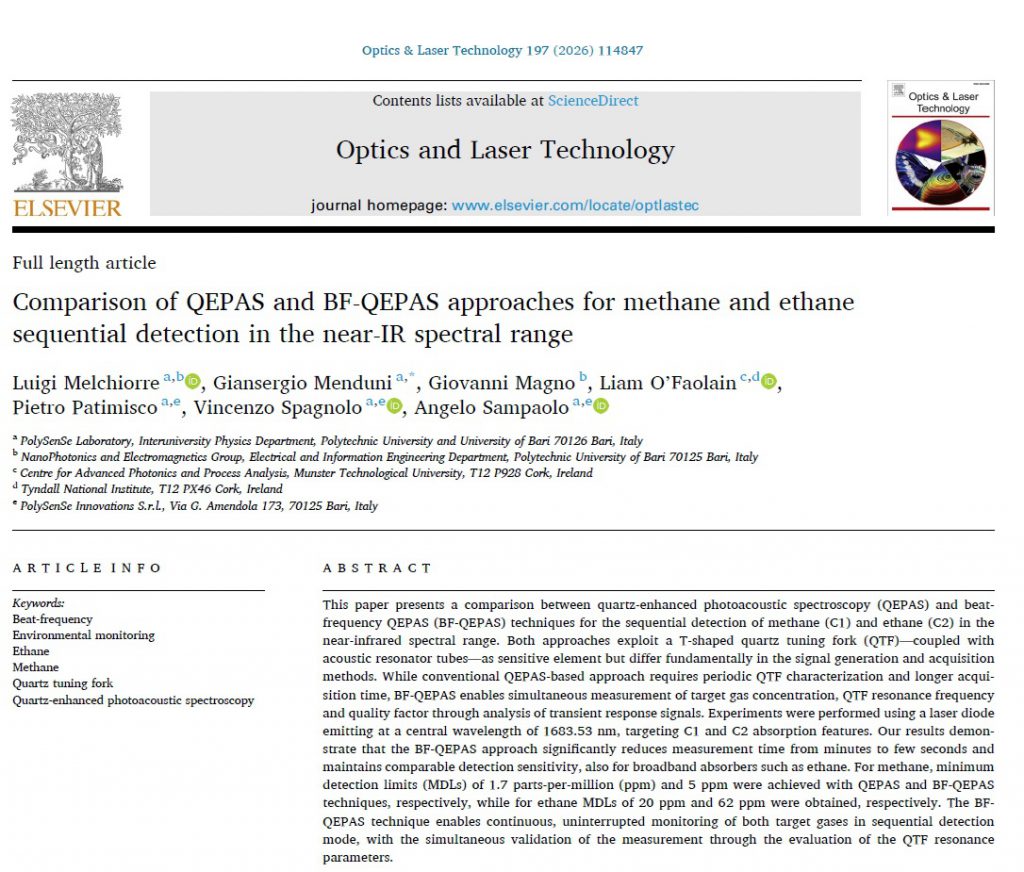
The PolySense and Polysense Innovations teams have just published a new article on Optics & Laser Technology journal (IF 5.0) reporting on a comparison between quartz-enhanced photoacoustic spectroscopy (QEPAS) and beat-frequency QEPAS (BF-QEPAS) techniques for the sequential detection of methane (C1) and ethane (C2) in the near-infrared spectral range. Experiments were performed using a laser diode emitting at a central wavelength of 1683.53 nm, targeting C1 and C2 absorption features. Our results demonstrate that the BF-QEPAS approach significantly reduces measurement time from minutes to few seconds and maintains comparable detection sensitivity, also for broadband absorbers such as ethane. For methane, minimum detection limits (MDLs) of 1.7 parts-per-million (ppm) and 5 ppm were achieved with QEPAS and BF-QEPAS techniques, respectively, while for ethane MDLs of 20 ppm and 62 ppm were obtained, respectively. The BF-QEPAS technique enables continuous, uninterrupted monitoring of both target gases in sequential detection mode, with the simultaneous validation of the measurement through the evaluation of the QTF resonance parameters.
The following link provides access to the article:
http://polysense.poliba.it/wp-content/uploads/2026/02/BF-QEPAS_2026.pdf