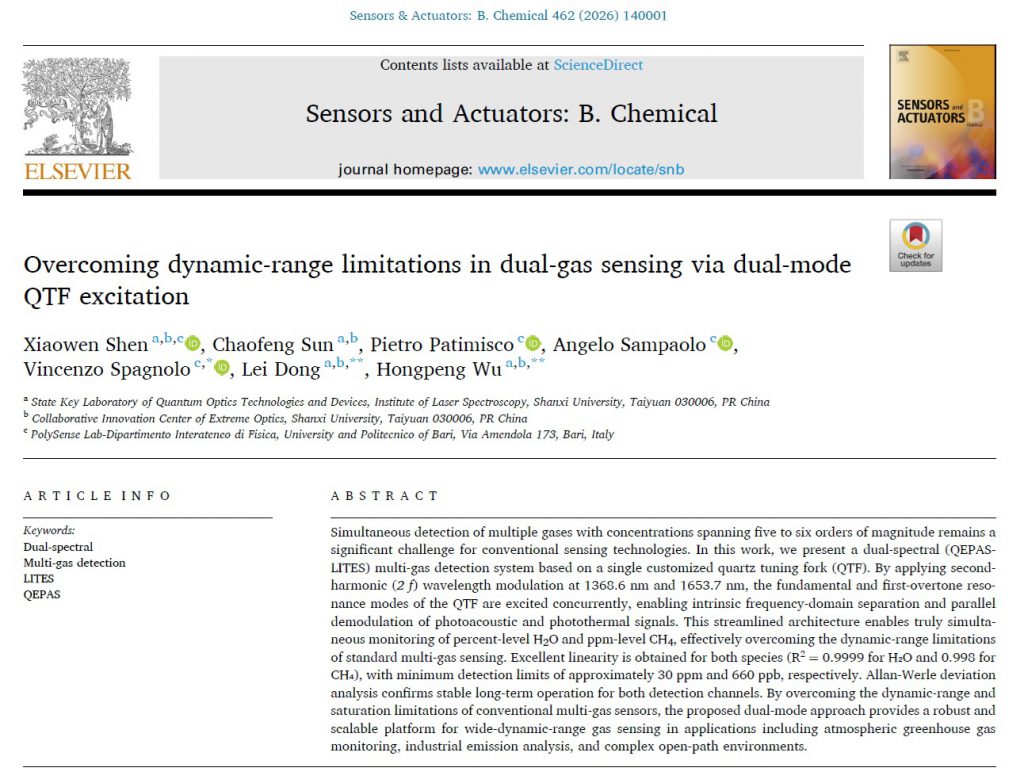
The PolySense and Polysense Innovations teams have just published a new article on Sensors and Actuators B Chemical Journal (IF 7.7) reporting on a dual-spectral (QEPAS-LITES) multi-gas detection system based on a single customized quartz tuning fork (QTF). By applying second-harmonic (2 f) wavelength modulation at 1368.6 nm and 1653.7 nm, the fundamental and first-overtone resonance modes of the QTF are excited concurrently, enabling intrinsic frequency-domain separation and parallel demodulation of photoacoustic and photothermal signals.
This streamlined architecture enables truly simultaneous monitoring of percent-level H2O and ppm-level CH4, effectively overcoming the dynamic-range limitations of standard multi-gas sensing. Excellent linearity is obtained for both species (R² = 0.9999 for H₂O and 0.998 for CH₄), with minimum detection limits of approximately 30 ppm and 660 ppb, respectively. Allan-Werle deviation analysis confirms stable long-term operation for both detection channels. By overcoming the dynamic-range and saturation limitations of conventional multi-gas sensors, the proposed dual-mode approach provides a robust and scalable platform for wide-dynamic-range gas sensing in applications including atmospheric greenhouse gas monitoring, industrial emission analysis, and complex open-path environments.
The following link provides access to the article:
http://polysense.poliba.it/wp-content/uploads/2026/04/1-s2.0-S0925400526005794-main.pdf